
Drilling
API 13A barite specification explained
What drilling-grade barite has to meet, and why each limit in the specification matters on the rig.

When a drilling contractor or mud company buys barite, the first question is usually whether it meets API 13A. API Specification 13A, published by the American Petroleum Institute, sets the requirements for drilling fluid materials, and barite is one of the most important of them.
The specification does not describe where barite comes from or how it is processed. It describes how the finished powder has to behave in a drilling fluid. That is why it focuses on a small number of physical and chemical properties.
The four main requirements
Drilling-grade barite under API 13A is judged on four properties. The values below are the commonly referenced limits. Always check the current edition of the specification for the exact figures and test methods.
| Property | Requirement |
|---|---|
| Density | At least 4.20 g/cm³ (barite 4.2) or 4.10 g/cm³ (barite 4.1) |
| Water-soluble alkaline earth metals, as calcium | Maximum 250 mg/kg |
| Residue greater than 75 µm | Maximum 3.0% by mass |
| Particles smaller than 6 µm | Maximum 30% by mass |
Density
Density is the reason barite is used at all. A weighting agent raises the density of the mud so that its hydrostatic pressure holds back the pressure in the formations being drilled. The denser the barite, the less of it is needed to reach a target mud weight, and the fewer solids end up in the fluid.
The original drilling grade called for a density of at least 4.20 g/cm³. As high-grade deposits became harder to find, a second grade with a minimum of 4.10 g/cm³ was added to the specification. Both are in use today, and buyers usually state which one they need.
Coarse residue above 75 µm
Particles coarser than 75 µm (roughly 200 mesh) settle out of the mud more easily and add wear to pumps and other equipment. Limiting this coarse fraction helps the barite stay suspended and keeps the fluid stable.
Fine particles below 6 µm
Very fine particles have a large surface area. Too many of them raise the viscosity of the mud and make it harder to control. The specification caps the share of particles under 6 µm so that the barite adds weight without thickening the fluid too much.
Soluble calcium
Water-soluble alkaline earth metals, measured as calcium, can react with other additives in water-based muds. Keeping them low means the barite behaves as an inert weighting material rather than changing the chemistry of the fluid.
What this means for buyers
An API 13A grade gives buyers a common reference point, but it is a minimum, not a full picture. Consistency from one shipment to the next matters just as much. Ask your supplier how they test each batch and what documents come with it.
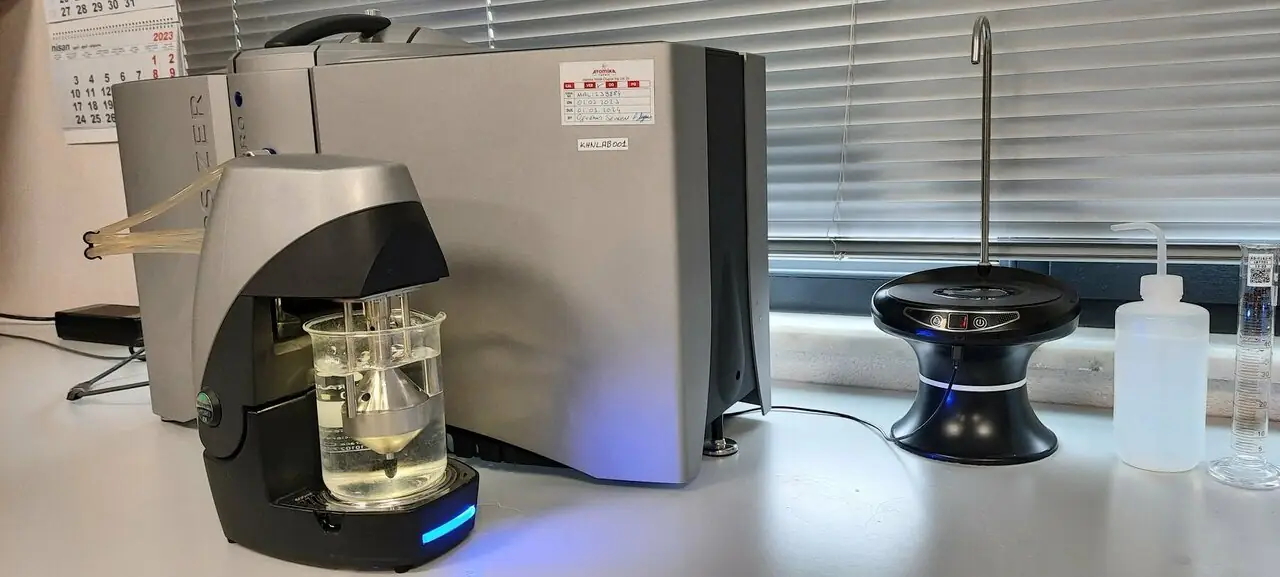
At KHN Minerals, quality control starts with XRF analysis of samples from our mine sites, and particle size is measured on a Malvern Mastersizer 3000 in our laboratory. We offer API barite options for drilling fluid applications.
Need API barite for your next well?
KHN Minerals mines barite at its own licensed sites in Konya and Isparta, micronizes it in Akyazı and tests it in its own laboratory. Tell us your application, grade and volumes.
- 97%typical BaSO4 in our ore
- 3barite mining licences
- 24 htarget reply time